at what angular frequency will the current amplitude be equal to 1/3 of its maximum possible value
15.6: Resonance in an Ac Circuit
- Folio ID
- 4446
Learning Objectives
By the end of the section, you will exist able to:
- Decide the peak air conditioning resonant angular frequency for a RLC circuit
- Explain the width of the average power versus angular frequency curve and its significance using terms similar bandwidth and quality factor
In the RLC serial circuit of Figure fifteen.4.1, the current aamplitude is, from Equation 15.4.7,
\[I_0 = \dfrac{V_0}{\sqrt{R^ii + (\omega L - i/\omega C)^2}}. \characterization{15.15} \]
If we can vary the frequency of the ac generator while keeping the aamplitude of its output voltage constant, then the electric current changes accordingly. A plot of \(I_0\) versus \(\omega\) is shown in Figure \(\PageIndex{one}\).

In Oscillations, we encountered a similar graph where the amplitude of a damped harmonic oscillator was plotted against the angular frequency of a sinusoidal driving force (see Forced Oscillations). This similarity is more than just a coincidence, as shown earlier by the awarding of Kirchhoff'south loop dominion to the excursion of Effigy 15.4.1. This yields
\[L\dfrac{di}{dt} + iR + \dfrac{q}{C} = V_0 \, \sin \, \omega t, \label{fifteen.16}\]
or
\[50\dfrac{d^2q}{dt^ii} + R\dfrac{dq}{dt} + \dfrac{1}{C}q = V_0 \, \sin \, \omega t,\]
where we substituted dq(t)/dt for i(t). A comparison of Equation \ref{fifteen.xvi} and, from Oscillations, Damped Oscillations for damped harmonic motion clearly demonstrates that the driven RLC series excursion is the electric analog of the driven damped harmonic oscillator.
The resonant frequency \(f_0\) of the RLC circuit is the frequency at which the aamplitude of the current is a maximum and the excursion would oscillate if not driven by a voltage source. By inspection, this corresponds to the athwart frequency \(\omega_0 = 2\pi f_0\) at which the impedance Z in Equation \ref{15.15} is a minimum, or when
\[\omega_0 L = \dfrac{ane}{\omega_0 C} \label{resonantfrequency1}\]
and
\[\omega_0 = \sqrt{\dfrac{1}{LC}}.\label{resonantfrequency2}\]
This is the resonant angular frequency of the excursion. Substituting \(\omega_0\) into Equation 15.4.5, Equation xv.4.7, and Equation 15.4.8, nosotros notice that at resonance,
\[\phi = tan^{-1}(0) = 0, \, I_0 = V_0/R, \, and \, Z = R.\]
Therefore, at resonance, an RLC circuit is purely resistive, with the applied emf and current in phase.
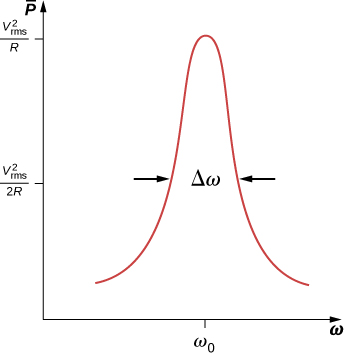
What happens to the ability at resonance? Equation 15.5.18 tells us how the average ability transferred from an air conditioning generator to the RLC combination varies with frequency. In addition, \(P_{ave}\) reaches a maximum when \(Z\), which depends on the frequency, is a minimum, that is, when \(X_L = X_C\) and \(Z = R\). Thus, at resonance, the average ability output of the source in an RLC serial excursion is a maximum. From Equation 15.5.18, this maximum is \(V_{rms}^2 /R\).
Figure \(\PageIndex{2}\) is a typical plot of \(P_{ave}\) versus \(\omega\) in the region of maximum power output. The bandwidth \(\Delta \omega\) of the resonance pinnacle is defined every bit the range of athwart frequencies \(\omega\) over which the average power \(P_{ave}\) is greater than one-half the maximum value of \(P_{ave}\). The sharpness of the peak is described by a dimensionless quantity known as the quality cistron Q of the circuit. By definition,
\[Q = \dfrac{\omega_0}{\Delta \omega}, \label{15.18} \]
where \(\omega_0\) is the resonant angular frequency. A loftier Q indicates a sharp resonance peak. Nosotros can give Q in terms of the circuit parameters as
\[Q = \dfrac{\omega_0L}{R}. \label{15.19} \]
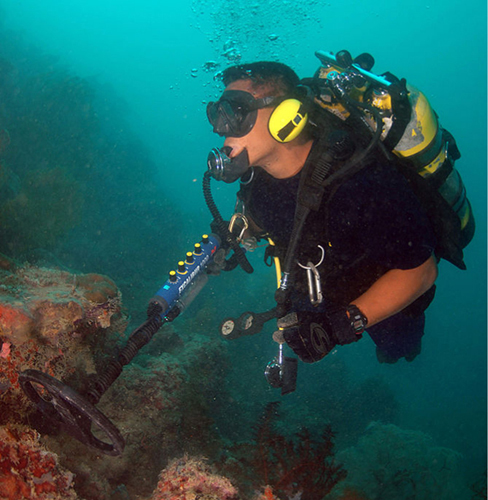
Resonant circuits are usually used to pass or turn down selected frequency ranges. This is done past adjusting the value of 1 of the elements and hence "tuning" the circuit to a particular resonant frequency. For example, in radios, the receiver is tuned to the desired station past adjusting the resonant frequency of its circuitry to match the frequency of the station. If the tuning circuit has a high Q, it will have a small bandwidth, and then signals from other stations at frequencies fifty-fifty slightly different from the resonant frequency encounter a high impedance and are not passed past the circuit. Jail cell phones piece of work in a similar way, communicating with signals of around 1 GHz that are tuned by an inductor-capacitor excursion. One of the most mutual applications of capacitors is their use in ac-timing circuits, based on attaining a resonant frequency. A metal detector also uses a shift in resonance frequency in detecting metals (Figure \(\PageIndex{3}\)).
Case \(\PageIndex{i}\): Resonance in an RLC Series Circuit
- What is the resonant frequency of the circuit of Case 15.3.i?
- If the air-conditioning generator is set to this frequency without irresolute the amplitude of the output voltage, what is the aamplitude of the current?
Strategy
The resonant frequency for a RLC circuit is calculated from Equation \ref{resonantfrequency2}, which comes from a residue between the reactances of the capacitor and the inductor. Since the circuit is at resonance, the impedance is equal to the resistor. So, the peak electric current is calculated by the voltage divided by the resistance.
Solution
- The resonant frequency is constitute from Equation \ref{resonantfrequency2}: \[\begin{align*} f_0 &= \dfrac{1}{2\pi} \sqrt{\dfrac{one}{LC}} \\[4pt] &= \dfrac{ane}{2\pi}\sqrt{\dfrac{1}{(iii.00 \times x^{-3} H)(eight.00 \times x^{-4}F)}} \\[4pt] &= i.03 \times 10^2 \, Hz. \stop{marshal*}\]
- At resonance, the impedance of the circuit is purely resistive, and the current amplitude is \[I_0 = \dfrac{0.100 \, 5}{iv.00 \, \Omega} = 2.fifty \times 10^{-2}A. \nonumber\]
Significance
If the excursion were not set up to the resonant frequency, we would need the impedance of the entire circuit to calculate the current.
Example \(\PageIndex{2}\): Power Transfer in an RLC Series Circuit at Resonance
- What is the resonant angular frequency of an RLC excursion with \( R = 0.200 \, \Omega, \, 50 = 4.00 \times 10^{-3} H\), and \(C = ii.00 \times 10^{-6}F\)?
- If an ac source of constant amplitude 4.00 V is set to this frequency, what is the average power transferred to the circuit?
- Determine Q and the bandwidth of this circuit.
Strategy
The resonant angular frequency is calculated from Equation \ref{resonantfrequency2}. The average power is calculated from the rms voltage and the resistance in the circuit. The quality factor is calculated from Equation \ref{15.19} and by knowing the resonant frequency. The bandwidth is calculated from Equation \ref{fifteen.18} and past knowing the quality gene.
Solution
- The resonant angular frequency is \[ \begin{align*} \omega_0 &= \sqrt{\dfrac{1}{LC}} \\[4pt] &= \sqrt{\dfrac{one}{(4.00 \times 10^{-three}H)(two.00 \times x^{-half dozen}F)}} \\[4pt] &= one.12 \times 10^4 \, rad/s. \terminate{align*}\]
- At this frequency, the average power transferred to the excursion is a maximum. It is \[P_{ave} = \dfrac{V_{rms}^2}{R} = \dfrac{[(1/\sqrt{2})(4.00 \, V)]^two}{0.200 \, \Omega} = 40.0 \, W.\]
- The quality gene of the circuit is \[Q = \dfrac{\omega_0L}{R} = \dfrac{(1.12 \times ten^4 \, rad/s)(4.00 \times 10^{-3}H)}{0.200 \, \Omega} = 224. \nonumber\] We then notice for the bandwidth \[\Delta \omega = \dfrac{\omega_0}{Q} = \dfrac{1.12 \times ten^4 \, rad/south}{224} = 50.0 \, rad/s. \nonumber\]
Significance
If a narrower bandwidth is desired, a lower resistance or college inductance would help. Yet, a lower resistance increases the power transferred to the circuit, which may not be desirable, depending on the maximum power that could perhaps be transferred.
Exercise \(\PageIndex{1}\)
In the excursion of Figure 15.four.1, \(L = 2.0 \times 10^{-3}H, \, C = five.0 \times 10^{-4} F\), and \(R = 40 \, \Omega\).
- What is the resonant frequency?
- What is the impedance of the circuit at resonance?
- If the voltage amplitude is 10 5, what is i(t) at resonance?
- The frequency of the AC generator is at present changed to 200 Hz. Summate the phase difference between the current and the emf of the generator.
- Answer
-
a. 160 Hz; b. \(40 \Omega\); c. \((0.25 A) \, \sin \, 10^3t\); d. 0.023 rad
Practice \(\PageIndex{2}\)
What happens to the resonant frequency of an RLC series excursion when the post-obit quantities are increased by a factor of iv: (a) the capacitance, (b) the self-inductance, and (c) the resistance?
- Reply
-
a. halved; b. halved; c. same
Practise \(\PageIndex{iii}\)
The resonant angular frequency of an RLC serial circuit is \(4.0 \times 10^2 \, rad/s\). An ac source operating at this frequency transfers an average power of \(2.0 \times 10^{-two} West\) to the circuit. The resistance of the circuit is \(0.l \, \Omega\). Write an expression for the emf of the source.
- Answer
-
\(v(t) = (0.xiv \, V) \, sin \, (iv.0 \times 10^2 t)\)
Source: https://phys.libretexts.org/Bookshelves/University_Physics/Book%3A_University_Physics_(OpenStax)/Book%3A_University_Physics_II_-_Thermodynamics_Electricity_and_Magnetism_(OpenStax)/15%3A_Alternating-Current_Circuits/15.06%3A_Resonance_in_an_AC_Circuit
0 Response to "at what angular frequency will the current amplitude be equal to 1/3 of its maximum possible value"
Post a Comment