When Is It Safe to Look at the Sun Again
Think the motion picture Sunshine, where astronomers acquire that the Sun is dying? So a plucky squad of astronauts take a nuclear bomb to the Sun, and try to spring-start it with a massive explosion. Yep, there's and so much wrong in that motion picture that I don't know where to start. So I just won't.
Seriously, a nuclear bomb to cure a dying Sun?
Hither's the thing, the Sun is really dying. Information technology's just that it's going to take nearly another five billion years to run of fuel in its core. And when it does, Cillian Murphy won't be able to restart it with a big nuke.
But the Sun doesn't have to die so soon. It'southward made of the aforementioned hydrogen and helium equally the much less massive red dwarf stars. And these stars are expected to last for hundreds of billions and even trillions of years.
Is there anything we can do to salve the Sun, or jump-start information technology when it runs out of fuel in the cadre?
First, let me explain the problem. The Sun is a main sequence star, and it measures one.4 million kilometers across. Like ogres and onions, the Sun is made of layers.

The innermost layer is the core. That's the region where the temperature and pressure level is then not bad that atoms of hydrogen are mashed together so tightly they can fuse into helium. This fusion reaction is exothermic, which means that information technology gives off more energy than it consumes.
The excess energy is released as gamma radiation, which then makes its mode through the star and out into infinite. The radiation pushes outward, and counteracts the in force of gravity pulling information technology together. This balance creates the Sun we know and love.
Outside the core, temperatures and pressures drop to the point that fusion tin no longer happen. This next region is known as the radiative zone. Information technology's plenty hot, and the photons of gamma radiation generated in the core of the Sun need to bounce randomly from atom to atom, maybe for hundreds of thousands of years to finally escape. Merely information technology's non hot enough for fusion to happen.
Outside the radiative zone is the convective zone. This is where the material in the Sunday is finally cool enough that it tin movement around similar a lava lamp. Hot blobs of plasma pick upward enormous heat from the radiative zone, float up to the surface of the Dominicus, release their oestrus and then sink downwards again.
The just fuel the Sun can use for fusion is in the core, which accounts for merely 0.8% of the Sun's volume and 34% of its mass. When information technology uses upwards that hydrogen in the core, it'll blow off its outer layers into space then shrink down into a white dwarf.
The radiative zone acts like a wall, preventing the mixing convective zone from reaching the solar core.
If the Sunday was all convective zone, and so this wouldn't be a problem, it would exist able to become on mixing its fuel, using up all its hydrogen instead of this smaller fraction. If the Sun was more similar a blood-red dwarf, it could last much longer.
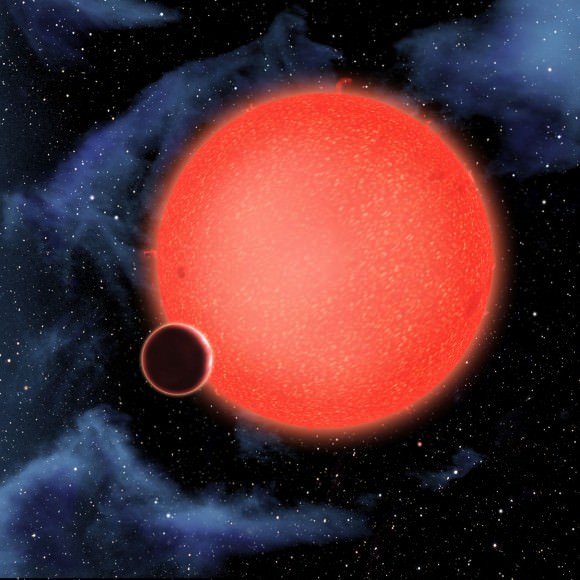
In lodge to save the Sun, to aid it last longer than the 5 billion years it has remaining, we would demand some way to stir upward the Sun with a gigantic mixing spoon. To become that unburned hydrogen from the radiative and convective zones down into the core.
One idea is that you could crash another star into the Sun. This would deliver fresh fuel, and mix upwardly the Sun'due south hydrogen a bit. But it would exist a one time affair. Y'all'd need to deliver a steady stream of stars to keep mixing it upwards. And after a while you lot would accumulate enough mass to create a supernova. That would be bad.
But some other option would be to strip cloth off the Sun and create ruby-red dwarfs. Stars with less than 35% the mass of the Sun are fully convective. Which means that they don't have a radiative zone. They fully mix all their hydrogen fuel into the core, and can concluding much longer.
Imagine a time to come civilization tearing the Lord's day into 3 separate stars, each of which could and so final for hundreds of billions of years, putting out only one.5% the energy of the Sun. Huddle up for warmth.
But if you want to take this to the farthermost, tear the Sun into 13 split up crimson dwarf stars with but 7.5% the mass of the Sun. These volition only put out .015% the calorie-free of the Sunday, but they'll sip abroad at their hydrogen for more 10 trillion years.
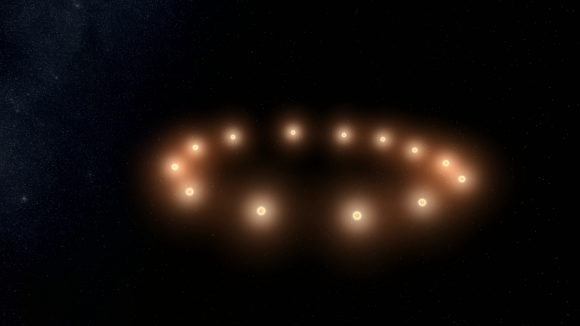
Simply how can you go that hydrogen off the Sun? Lasers, of grade. Using a concept known as stellar lifting, you lot could direct a powerful solar powered light amplification by stimulated emission of radiation at a spot on the Sunday's surface. This would oestrus up the region, and generate a powerful solar wind. The Dominicus would be blasting its own textile into infinite. Then you could use magnetic fields or gravity to direct the outflows and collect them into other stars. It boggles our imagination, but it would be a routine chore for Type III Civilisation engineers on star dismantling duty.
And then don't panic that our Sun only has a few billion years of life left. We've got options. Mind bendingly complicated, solar organization dismantling options. But still… options.
Podcast (audio): Download (Elapsing: half-dozen:31 — 2.4MB)
Subscribe: Apple Podcasts | RSS
Podcast (video): Download (Elapsing: six:33 — 85.3MB)
Subscribe: Apple Podcasts | RSS
Source: https://www.universetoday.com/130989/can-save-sun/
0 Response to "When Is It Safe to Look at the Sun Again"
Post a Comment